
Chicken & Turkey Temperature Guide
One number for safety, three places to check it, and roast times by weight.
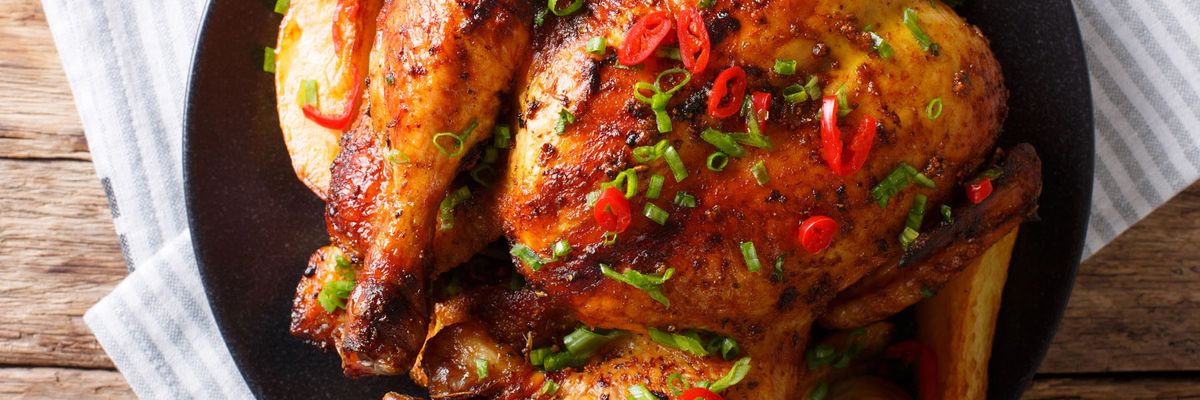
Poultry is the easy part of the temperature question and the hard part of the cooking. The safe number is the same for every part of every bird: 165°F. The trouble is that a whole chicken or turkey is two different meats sharing one skeleton. The breast is lean and dries out fast. The thighs are full of connective tissue and want more heat. They finish at different times. This guide covers where to measure, how long a bird takes, and how to get both halves right.
The safe temperature: 165°F
USDA sets one minimum for all poultry: whole birds, breasts, legs, thighs, wings, ground poultry, giblets, and stuffing cooked inside the bird. It's 165°F, and unlike beef and pork, there's no rest-time requirement attached. Once the thickest part reads 165°F, you're safe.
Poultry gets a higher number than a pork chop because of the bacteria involved. Salmonella and Campylobacter are common on raw poultry, and you can't count on a chicken breast to keep them politely on the surface the way a whole beef steak does. Poultry also gets handled, cut and packed in ways that move surface bacteria around.
Where to check a whole bird
USDA says check three places, and all three need to read 165°F:
- The innermost part of the thigh, close to the body but not touching bone. This is usually the last spot to get there.
- The innermost part of the wing.
- The thickest part of the breast.
If your turkey came with a pop-up timer, check with a thermometer anyway. USDA recommends it, and pop-ups can be wrong in either direction. If the bird is stuffed, the middle of the stuffing has to hit 165°F too.
Dark meat vs. white meat
Thighs and drumsticks are safe at 165°F, but most cooks like them better at 175–185°F. Dark meat has more fat and connective tissue, and that collagen softens as it gets hotter, so the meat goes from chewy to tender. Breast meat is lean and gets drier with every degree past 165°F.
So a whole bird is always a compromise, and the tricks for cooking one are mostly about letting the legs get ahead of the breast:
- Spatchcock it. Cut out the backbone and press the bird flat. The legs sit level with the breast instead of tucked underneath, and the whole thing cooks faster and more evenly.
- Shield the breast. A piece of foil over the breast for part of the roast slows it down. USDA's turkey guide also suggests a foil tent for the first hour or so if your pan doesn't have a lid.
- Cook the parts separately. Feeding a crowd? Roast breasts and thighs on separate pans and pull each one at its own best temperature.
Chicken roasting times (USDA chart)
| Type | Weight | Oven | Time |
|---|---|---|---|
| Chicken, whole | 3 to 4 lb | 350°F | 1¼ to 1½ hours |
| Chicken, whole | 5 to 7 lb | 350°F | 2 to 2¼ hours |
| Chicken breast halves, bone-in | 6 to 8 oz | 350°F | 30 to 40 minutes |
| Chicken breast halves, boneless | 4 oz | 350°F | 20 to 30 minutes |
| Capon, whole | 4 to 8 lb | 350°F | 2 to 3 hours |
| Cornish hen, whole | 18 to 24 oz | 350°F | 50 to 60 minutes |
| Duck, whole (do not stuff) | 4 to 6 lb | 350°F | 30 to 35 min/lb |
| Duck, legs or thighs | 325°F | 1¼ to 1½ hours | |
| Young goose, whole | 8 to 12 lb | 325°F | 2½ to 3 hours |
Heads up on the boneless breast row: it's for a 4-ounce piece. Most supermarket breasts these days weigh 7 to 10 ounces (somewhere, a chicken is doing a lot of leg day), so they'll take longer. Pounding them to an even thickness, or slicing them in half horizontally, gets you closer to the chart and cooks the thin end and the thick end at the same rate. USDA adds 15 to 30 minutes for stuffed birds.
Turkey roasting times by weight (USDA chart)
Oven at 325°F, turkey fully thawed. These are ballpark; the thermometer has the final say.
| Turkey size | Unstuffed | Stuffed |
|---|---|---|
| 4 to 6 lb (breast) | 1½ to 2¼ hours | Not usually applicable |
| 6 to 8 lb (breast) | 2¼ to 3¼ hours | 3 to 3½ hours |
| 8 to 12 lb | 2¾ to 3 hours | 3 to 3½ hours |
| 12 to 14 lb | 3 to 3¾ hours | 3½ to 4 hours |
| 14 to 18 lb | 3¾ to 4¼ hours | 4 to 4¼ hours |
| 18 to 20 lb | 4¼ to 4½ hours | 4¼ to 4¾ hours |
| 20 to 24 lb | 4½ to 5 hours | 4¾ to 5¼ hours |
Plan on about a pound of turkey per person. Let the bird stand 20 minutes before you carve; USDA recommends it for quality, and it makes slicing easier. That rest is also your window to make the gravy.
Stuffed or not?
USDA's advice is don't stuff the bird. Bake the stuffing in its own dish. Stuffing inside the cavity is insulated by all that turkey and is often the last thing to hit 165°F. By the time it gets there, the breast has usually blown past its number.
If you stuff anyway: mix the wet and dry ingredients right before you fill it, pack it loosely, get the turkey in the oven right away, and check the center of the stuffing with a thermometer. Never buy a fresh turkey that's been pre-stuffed. Frozen pre-stuffed turkeys with a USDA or state inspection mark are fine, but cook them from frozen, following the package.
Turkey from frozen, and thawing
You can roast a turkey that's still frozen; USDA says it takes at least 50% longer. Fish the giblet packet out with tongs once it loosens up. If you'd rather thaw it, give it about a day in the fridge for every 4 to 5 pounds, or about 30 minutes per pound in cold water. The thawing guide has the full table.
Brining, briefly
A brine (salt in water) or a dry brine (salt rubbed on, then left in the fridge) seasons poultry and helps it hold on to moisture, which buys you a little margin on the breast. It doesn't change the safe temperature. Brined birds brown faster, so keep an eye on the skin. Keep a brining bird in the fridge, not on the counter or in a cooler that drifts above 40°F.
- USDA Food Safety and Inspection Service, Safe Minimum Internal Temperature Chart
- USDA FSIS, Let's Talk Turkey: A Consumer Guide to Safely Roasting a Turkey
- FoodSafety.gov, Meat and Poultry Roasting Charts
- Dark-meat temperature preferences are common kitchen practice, not a USDA standard.